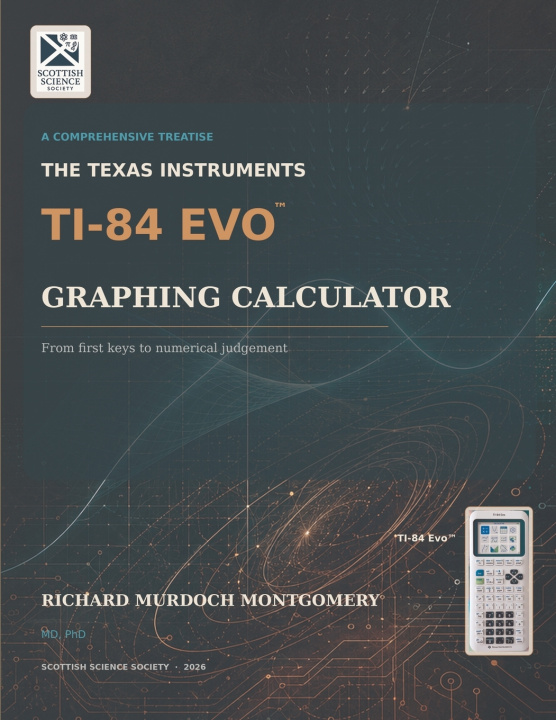
There are instruments which disappear into the hand and instruments which insist upon being noticed. A pencil belongs to the first class; a new graphing calculator, arriving with a brighter screen, a revised keyboard and a small procession of promises, belongs emphatically to the second. Yet the distinction does not last. Once an instrument has been properly understood, its surfaces cease to interrupt thought. The hand knows where to go, the eye knows what to distrust, and the mind is released from the petty taxation of menus. This book is intended to hasten that fortunate disappearance.
The TI-84 Evo is not merely the latest occupant of a familiar numerical household. It preserves a language of functions, lists, matrices, graphs and programs that has been taught for decades, while altering the manner in which the user encounters that language. An icon-based Home Screen replaces the older presumption that every command should be remembered before it may be found; the graphing field is enlarged; points of mathematical interest announce themselves during tracing; lines and conics receive a more deliberate environment; Python stands beside TI-Basic; and USB-C, at last, permits the cable drawer to surrender one of its minor absurdities. None of these changes abolishes the need to understand mathematics. They make that need more visible, because an answer obtained quickly can be believed incorrectly with corresponding speed.
The proper study of a calculator is therefore neither button worship nor button disdain. The first confuses facility with knowledge; the second mistakes inconvenience for intellectual virtue. A graphing calculator is valuable when it moves the learner among numerical, graphical and algebraic representations, when it permits conjecture to be made cheaply and correction to be made without humiliation, and when its output is treated as evidence to be judged rather than an oracle to be obeyed. Research on graphing-calculator teaching has long suggested that access alone is insufficient: curriculum, pedagogy and the user's habits determine whether the instrument enlarges or merely accelerates thought (Kastberg Leatham, 2005). The pages that follow are constructed around that sterner and more fruitful proposition.
The reader will consequently be asked to do more than imitate keypresses. Every procedural sequence is preceded by the mathematical object it is meant to represent and followed by an independent check. Every equation is derived before it is numbered. Every graph is interpreted before it is admired. Where the calculator is exact, we shall say why; where it is approximate, we shall ask how approximate; where it is silent, we shall resist the vulgar temptation to fill the silence with confidence.
One may begin this volume as a novice and finish it as a competent calculator programmer, statistical analyst and numerical modeller. The route is progressive, but not condescending. Elementary operations are examined with the same care later given to regression, numerical integration and differential equations, for the elementary is not the opposite of the profound; it is usually the place where the profound has been folded until it fits in a pocket