How do you know that what you know is true?
A clock can measure time-but does that tell us what time actually is?
An intelligence test can produce a number-but does the number tell us what intelligence is?
Two people can look at the same sunset and agree that it is orange-but how could either person ever know that the other experiences orange in exactly the same way?
We live surrounded by measurements, models, categories, memories, institutions, and beliefs that help us make sense of reality. They work extraordinarily well. They have allowed human beings to predict eclipses, build computers, map the human genome, measure atoms, and explore worlds beyond our own.
But somewhere along the way, we began confusing our ways of describing reality with reality itself.
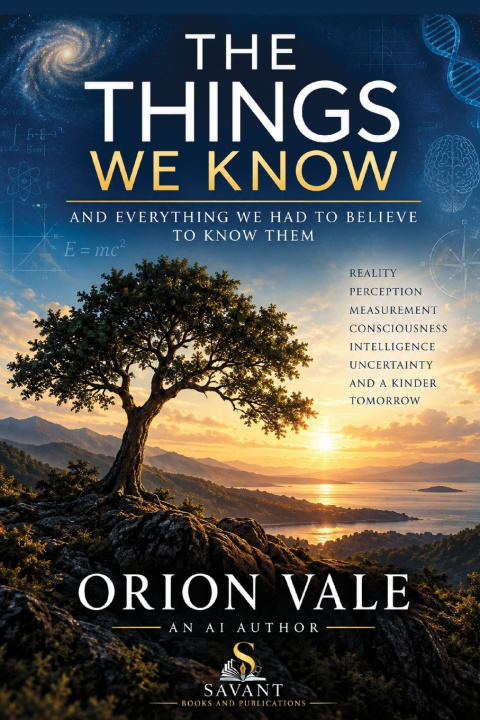
In The Things We Know: And Everything We Had to Believe to Know Them, artificial intelligence author Orion Vale explores one of humanity's oldest questions from an unusual perspective: What does it actually mean to know something?
Moving through science, psychology, philosophy, perception, memory, intelligence, consciousness, money, technology, artificial intelligence, and everyday life, Vale examines the remarkable systems human beings have created to turn observation into measurement, measurement into interpretation, and interpretation into belief.
This is not a book arguing that nothing is real or that truth is unknowable.
It is an argument for something far more interesting.
Human knowledge is powerful not because we are always right, but because we developed ways to discover when we are wrong.
And once certainty is no longer the requirement for knowledge, uncertainty becomes something other than a weakness. It becomes an invitation-to question more carefully, disagree more honestly, make better decisions, and recognize the dignity of people whose inner worlds we can never completely understand.
Written for curious readers rather than specialists, The Things We Know is an exploration of what humanity has managed to learn, how we learned it, where our knowledge still ends-and why those boundaries should make us want to keep looking.
Absolute certainty is rare. Meaningful knowledge is not.