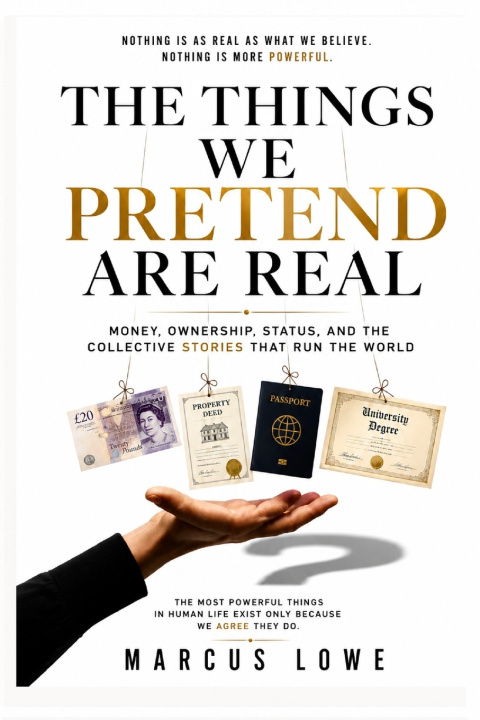
A twenty pound note is a piece of paper. A border is a line that exists only in human minds. Land ownership is a legal agreement enforced by institutions that were themselves invented. Status is a competition for something that was never objectively defined.
And yet people spend their entire lives chasing these things. Fighting for them. Building their identities around them. Dying for them.
Why?
Because billions of people are participating in the same story. And when enough people believe the same story, the story becomes real. Not real in the way that water is real, or pain is real, or love is real. But real in its consequences. Real enough to determine who eats and who does not. Who has opportunity and who does not. Who counts and who does not.
This book is about the machinery behind that reality: the specific, extraordinary human ability to create systems of collective belief that reshape the world, and the question of whether the systems we have built are actually serving us, or whether we have lost the ability to tell the difference between the story and the thing it was supposed to represent.
Inside, you will find:
- Why money works, why it should not work, and what it actually is
- How humans became the only species capable of cooperating with millions of strangers, and why shared stories are the answer
- The history of what has been used as money, from cowrie shells to stone discs to digital numbers, and what that history reveals about what money actually is
- Why gold is expensive and water is not, and what the answer tells you about the difference between price and value
- Whether anyone can truly own land, and what the honest answer means for everything built on that assumption
- Why borders are lines that exist only in agreement, and how those invisible lines determine the life outcomes of billions of people
- The wealth trap: why rich societies are not always happy societies, and what the research actually shows about what produces human wellbeing
- Status as humanity's oldest currency, and why the chase for it tends to undermine the things that actually matter
- What would happen if money disappeared tomorrow, and whether humans would become kinder or simply invent new hierarchies
- What is actually real, and which stories are worth believing
This is not a book about economics. It is not a book about politics. It is a book about something deeper than both: the specific human superpower that built civilization, and the question of whether we are using it wisely.
Civilization is not built from concrete. It is built from belief.
The question is not whether we live inside stories. The question is whether we are awake inside them.