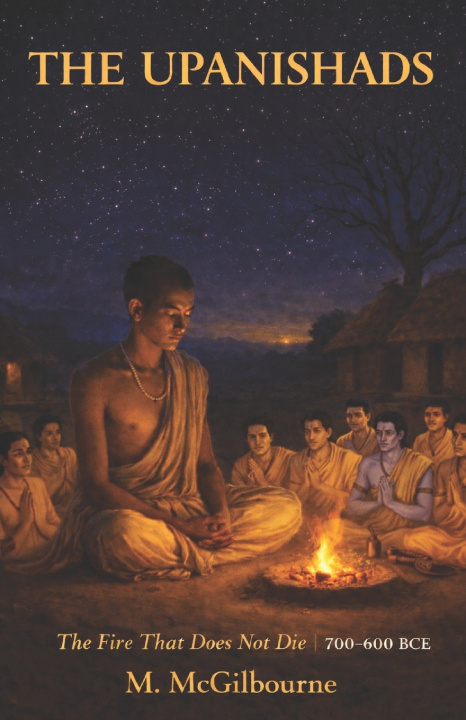
The Fire That Does Not Die 700-600 BCE
You are the end point of an unbroken chain of survival. Every person who came before you - through plague, war, famine, and flood - lived long enough to pass forward what was necessary for you to exist. You did not begin when you were born. You began when humanity began. Everything that happened between that beginning and this moment is not the past in any abstract sense. It is the story of the making of you.
This book takes you to one of the most extraordinary moments in that story. Northern India. The Gangetic Plain. 600 BCE. A civilization is turning inward. In the forest ashrams and royal courts stretching from Kuru to Videha, ordinary people are asking a question no civilization has asked with such force before. Not what must we sacrifice. Not which god must we appease. But what am I - beneath everything I was trained to be? The texts they produced predate the Greek philosophers and the Buddha. The arguments about what they discovered have never stopped.
The Fire That Does Not Die asks what it meant to be inside that moment. Not as a king. Not as a sage. But as the ordinary young priest who recited ten thousand hymns in faultless Sanskrit and one morning knelt before the household fire and found that the words, perfectly spoken, no longer reached the thing they were supposed to touch. What did the seekers feel when a teacher said: strip away your name, your role, your memory, your thoughts - and tell me what remains? What is the difference between a ritual and a truth - when the people performing it saw no difference at all?
The facts are extraordinary enough.
The Brihadaranyaka Upanishad is among the oldest philosophical texts in any world tradition - and a woman, Maitreyi, is one of its central voices.
At a royal tournament in Mithila, the philosopher Yajnavalkya claimed one thousand prize cattle before a single debate began. Then defeated every challenger.
The teaching tat tvam asi - that thou art - compressed the identity of the individual self with ultimate reality into three Sanskrit words.
A student named Nachiketa traveled, in the tradition's great story, to the realm of death - and refused kingdoms and gold in exchange for one thing only: the truth of what survives.
History is not a sequence of dates. It is the record of billions of lives lived forward through a present that was, to each of them, as urgent as your own. At dawn a young man feeds a fire with three sticks of dry sal wood, smallest first. Ghee pours into the flame. Sanskrit begins in the dark, faultless, and the plain stretches flat to every horizon. They were curious about the same things we are curious about. They asked something that is still asking us questions.
For homeschooling families: You are already doing the most important thing - putting the story of humanity directly into your children's hands. The Beyond His Story We Stand series was written for you. Each book takes one moment in human history and makes it lived rather than memorised, felt rather than filed away. Not a textbook. Not a syllabus. A story your child will not want to put down - and that will leave them asking the questions that no curriculum can generate for them. The questions that only wonder produces.
The Fire That Does Not Die is Book 9 of the Beyond His Story We Stand series - a chronological journey through human history, told through the eyes of the people official history forgot to record.
The question survived. Passed from one open mouth to one leaning ear, across twenty-six centuries, to you. It is still waiting for your answer.