The old world still has the costume.
The seals. The flags. The banks. The courts. The platforms. The dashboards. The credentials. The emergency language. The sacred words.
Trust. Safety. Progress. Democracy. Markets. Innovation. Civilization.
But the behavior no longer matches the costume.
People still go to work. They still use banks. They still log in. They still pay taxes. They still fill out forms. They still comply with the dashboard.
The old system thinks this means confidence remains.
It does not.
It means dependency remains.
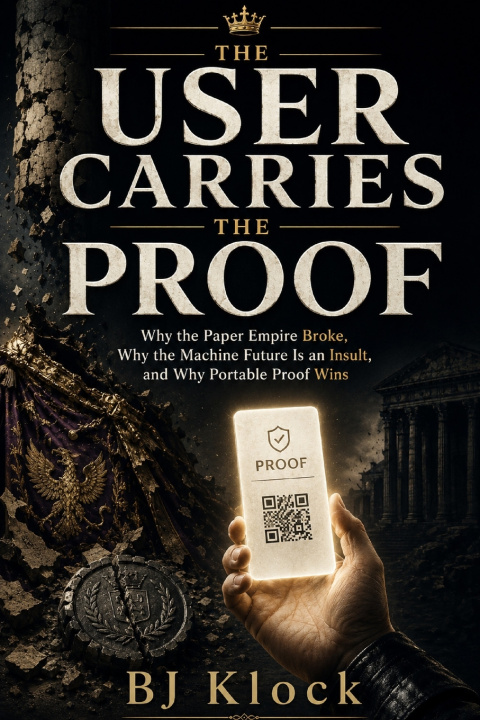
The User Carries the Proof is a sharp, uncompromising manifesto about the collapse of institutional trust, the failure of paper authority, the rise of dashboard custody, and the machine future being sold as progress.
BJ Klock argues that the crisis of the age is not simply political, financial, or technological. It is a crisis of proof.
The record moved away from the person.
The receipt moved behind a login.
The proof moved into the dashboard.
The human became a managed account.
The machine started calling captivity convenience.
And now the old custodians want more.
More data. More identity layers. More dashboards. More AI mediation. More behavioral management. More custody. More "seamless" systems that make the human being easier to administer and harder to exit.
This book says no.
The future is not the human plugged deeper into the machine.
The future is proof moving closer to the person.
Portable proof. Object-level memory. Offline verification. Receipts that travel. Records that can leave. Technology that serves the human instead of absorbing him.
This is not anti-technology.
It is anti-custody.
It is not nostalgia.
It is the next trust primitive.
The old world says: trust the institution.
The dashboard age says: log in to view.
The machine future says: plug in to keep up.
The proof future says something better:
Carry the receipt.
The user is not the terminal.
The user is the sovereign.
And the sovereign carries the proof.