The oldest question a civilization can ask is not whether it will survive. It is whether, having survived, it will recognize itself.
The year is approximately 2680. Two posthuman civilizations - the Continuants of the inner system, who archived their minds across centuries, and the Emergents of the outer moons, who engineered their biology beyond recognition - have spent three hundred years administering humanity's greatest project together: the Helios Compact, a partial Dyson sphere that will one day carry what remains of the species beyond a dying sun.
When the Compact's joint governor dies mid-ceremony, a succession crisis begins. The ancestral vote is stolen - not through fraud, but through the patient, legal accumulation of proxies over thirty years. The process is followed. The outcome is wrong. And the man who inherits the loss, Tuvrak, cannot bring himself to break the mechanism that betrayed him, because he believes - correctly, catastrophically - that the alternative is worse.
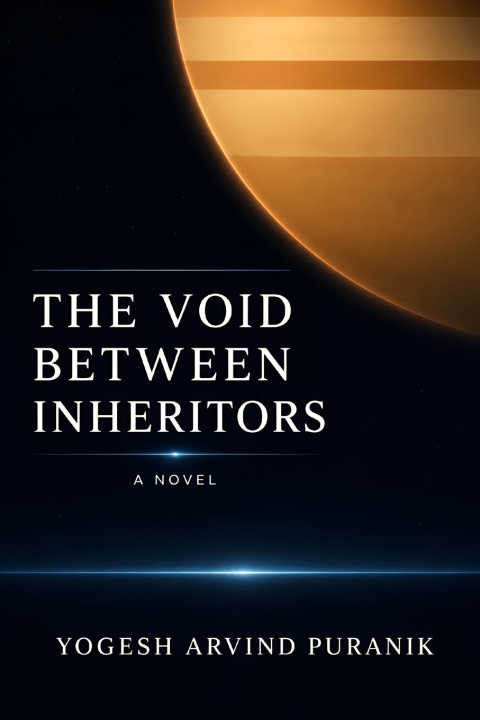
The Void Between Inheritors follows five movements across thirteen years and eighteen days of war. It is a novel about what happens when the institutions people build to protect justice are used, precisely and legally, to destroy it. About a terraforming architect who spends twenty-four years building a sky on Europa because the work is real and the obstruction is not. About brothers who prepared for a war they hoped they were wrong about. About an autonomous systems arbitrator, one hundred and eighty years old, who asks questions no one has thought to file and disappears when the questions run out.
It is also a novel about a child named Neva, seven years old, born into the first open sky on a moon that had no business having one. She does not know what it cost. The novel's last line belongs to her.
The Void Between Inheritors is literary science fiction grounded in real physics, real political psychology, and the oldest questions philosophy has: What makes you you across radical change? What do the living owe the dead? What do we owe those who come after us, if they may no longer recognize us as their own?
This novel does not answer these questions. It is the space in which they are asked - with complete precision, and without flinching.
For readers of serious science fiction.
For anyone who has ever trusted a process and watched it fail.