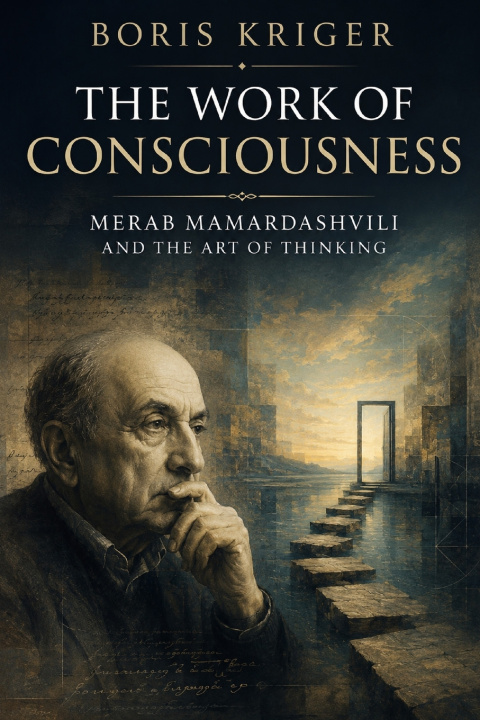
What is it that we do when we think? We imagine the mind as a mirror, faithfully reflecting a world that shines in through the senses. It is nothing of the kind. The mind is a fire that exists only while it burns - an activity, not a container; a verb, not a vessel.
In The Work of Consciousness, the philosophy of Merab Mamardashvili - who taught that consciousness is something one performs, that the self is made rather than possessed, and that each person is uniquely and irreplaceably charged with the task of becoming - is brought into living dialogue with a contemporary structural theory of mind. The result is a book that confirms Mamardashvili's vision in startling detail and then, in fairness to him, quarrels with it.
Across thirty-three chapters, it follows a single thread from the ancient command "know thyself" to the frontier of brain science: why we cannot see straight, why memory rebuilds rather than replays the past, why the mind must predict the world it can never directly perceive, why the self that revises itself is free precisely because it can never fully know itself. It explains why crowds manufacture realities no individual built, why creativity lives next door to breakdown, and why some truths cannot be combined but only navigated between, by flashes, like lightning.
Rigorous without a single equation, and written for any reader willing to think hard about thinking, this is a book about the one labor none of us can delegate - the endless, twilit, never-finished work by which a mind becomes someone.
Keywords
philosophy of mind · consciousness · Merab Mamardashvili · self-knowledge · phenomenology · predictive processing · the examined life