A three-phase motor refuses to start. It hums but will not turn. The overload trips after a few minutes. The motor runs hot, vibrates, draws unbalanced current, or suddenly begins rotating in the wrong direction.
The motor may not be the real problem.
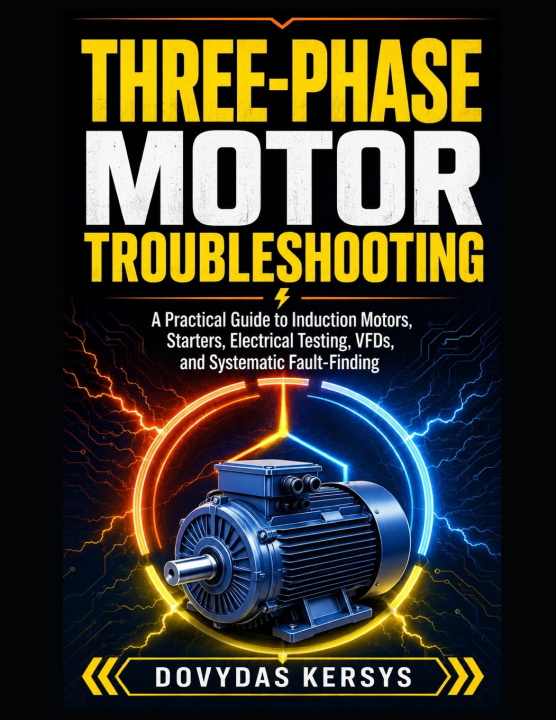
Three-Phase Motor Troubleshooting is a practical guide for maintenance technicians, industrial electricians, engineers, and students who need to understand, test, and diagnose three-phase induction motors without relying on guesswork or unnecessary part replacement.
The book begins with the principles that explain how a three-phase motor works, including three-phase power, the rotating magnetic field, induction, slip, and motor loading. It then connects those fundamentals to real motor circuits, electrical measurements, and common industrial faults.
Inside, you will learn how to:
- Understand three-phase power and rotating magnetic fields
- Explain induction, slip, torque, and starting current
- Read motor nameplates and interpret their ratings
- Identify correct star and delta winding connections
- Understand direct-on-line and star-delta starting
- Follow motor power and control circuits
- Troubleshoot contactors, starters, overload relays, and protection
- Measure and compare all three phase voltages and currents
- Recognize voltage and current imbalance
- Test motor insulation with an insulation resistance tester
- Check winding resistance, continuity, and phase balance
- Diagnose a motor that will not start
- Find single-phasing and lost-phase conditions
- Investigate overheating, overload trips, and excessive current
- Separate electrical motor faults from mechanical load problems
- Diagnose bearing noise, vibration, misalignment, and mechanical binding
- Troubleshoot motors controlled by variable frequency drives
- Apply a repeatable, systematic fault-finding method
- Use preventive maintenance to identify developing problems before failure
The book emphasizes an important troubleshooting principle: a motor problem is not always caused by the motor itself. The fault may be in the power supply, contactor, overload relay, control circuit, cable, winding connection, driven equipment, bearings, or VFD.
Practical fault examples show how symptoms such as humming, tripping, overheating, weak torque, high current, wrong rotation, vibration, and failure to start can be used to narrow the possible causes.
The book is written with awareness of both NEC/NEMA and IEC conventions, making it useful for readers working with North American and international industrial equipment. It covers both traditional across-the-line motor circuits and modern VFD-driven applications.
Whether you are learning motor troubleshooting for the first time or need a structured reference for daily maintenance work, this guide will help you approach three-phase motor faults safely, logically, and confidently.
Understand the motor. Test the circuit. Find the fault.