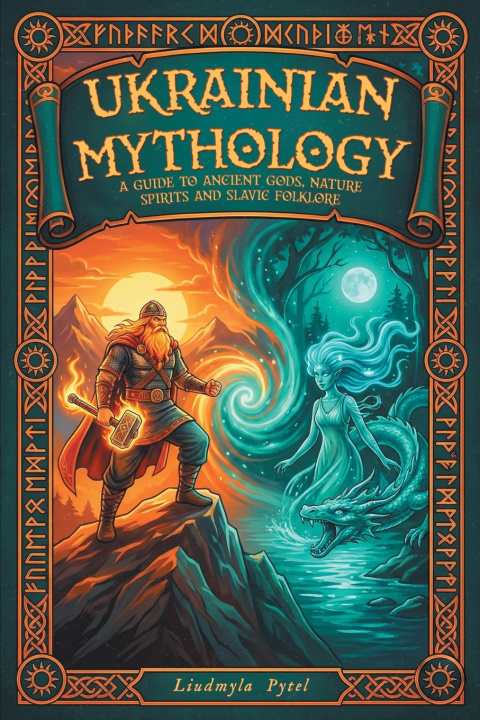
Meet the gods, spirits, and monsters that Ukraine has whispered about for a thousand years - ancient Slavic folk memory, told for today's reader.
Long before the golden domes of Kyiv, the Slavic world pulsed with hidden life: the forest had its rules, the water kept its secrets, fire demanded respect, and every house sheltered a spirit of its own. While Homer's epics fixed the Greek pantheon in writing, the Slavic tradition entrusted its legacy to the living voice - songs, rituals, and oral tales that outlasted centuries of silence. Ukrainian Mythology gathers those traces into twenty-one vivid portraits, grounded in medieval chronicles, epic poetry, and genuine folk memory rather than modern reinvention.
Inside - three realms of the Slavic imagination:
The major deities. In ancient Kyiv, princes and warriors bowed to Perun the thunderer on the hill, while merchants and farmers by the river bowed to Veles, lord of cattle, wealth, and the underworld - two gods sworn side by side in the treaties between Kyivan Rus and Byzantium. With them: Dazhbog the giving sun, Mokosha the great mother, Svarog the celestial smith, and Lada, goddess of spring and love.
Nature and home spirits. The Domovyk purring behind the stove - and the felt-boot ritual for moving him to a new house; the forest lord Lisovyk; the alluring Rusalka and Mavka; the wild Chugaister of the Carpathians; and the treasure-bringing Hodovanets.
Creatures of darkness and chaos. The dragon Zmiy, the vampire Upyr, the witch Vidma, the werewolf Vovkulaka, the nightmare Mara, the fiery seducer Perelesnyk - and Viy, the iron-faced terror whose deadly gaze Gogol made famous.
More than a catalogue of names, this is a guide to a uniquely Ukrainian way of seeing the world - and to a tradition still alive today. Discover why October 31 belongs to Veles Night rather than Halloween; how the old gods survived Christianization disguised as saints - Veles as Saint Vlas, Perun as Saint Elias; why medieval bards were called "grandsons of Veles"; and why many Ukrainians still avoid whistling indoors and sit in silence before a journey - customs that began as pacts with the spirits of the house.
An author's note explores the enigmatic "missing deities" of Volodimir's pantheon of 980 CE - Simargl, Khors, and Stribog - and a bibliography spans scholarly works, the Primary Chronicle, The Tale of Igor's Campaign, Gogol, Kotsiubynsky, and Lesya Ukrainka, making the book a reliable first reference as well as an engaging read.
Illustrated with more than twenty full-page plates, Ukrainian Mythology is an accessible introduction, a lasting reference, and a natural gift for readers of Slavic folklore and comparative mythology, lovers of folk horror and dark fairy tales, students of Eastern European culture, and anyone drawn to the deep roots of Ukraine.