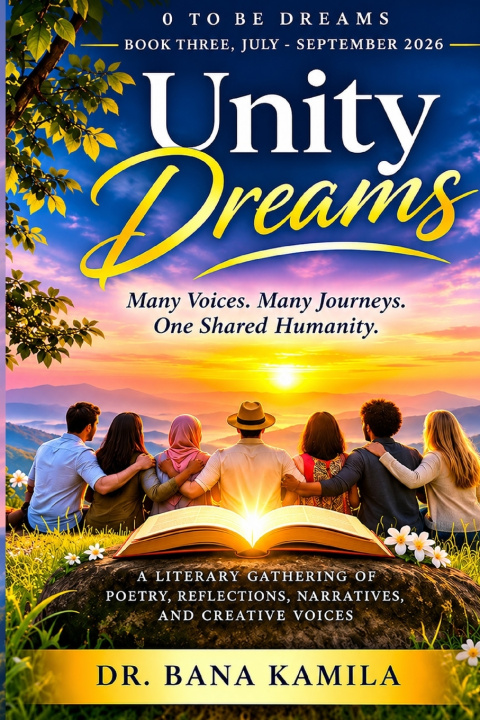
Unity Dreams: what if a poem could cross the distance between strangers?
What if a voice from another country, another generation, another way of living could reveal something you had never quite understood about yourself?
And what if unity were not the end of difference, but the beginning of a deeper kind of belonging?Unity Dreams invites you to enter that possibility.
In this third book of the 0 to Be Dreams series, following Big Dreams and Peace Dreams, Dr. Bana Kamila brings together a literary community whose words travel beyond borders, labels, and expectations. The result is more than a collection of poems. It is a many-voiced encounter with the questions that shape our lives: Who am I among others? How do we honor what makes us different? Can we listen without demanding agreement? What does it take to turn a solitary dream into a shared human hope?
Many Voices! Many journeys!
One shared humanity dream!
The book unfolds in dream movements, each opening another door. A searching, novelistic essay begins with an unlikely symbol: 0. Rather than absence, 0 becomes possibility, the place from which an individual may grow into a community without vanishing into it. Reflections gathered around India's Independence Day carry that question into the lived realities of diversity, inviting readers to imagine solidarity across caste, creed, gender, language and circumstance.
Dr. Kamila then steps forward not only as editor, but as a fellow writer, sharing fiction and poetry that explore dreaming, affection, memory and the pull of belonging. At the collection's heart stand fifteen honored poetesses and fifteen honored poets. Their profiles and creative work give the reader not an anonymous chorus, but distinct lives and imaginations to meet. No two voices need to sound alike for the gathering to become meaningful.
The final movements offer a more intimate scale: five poems by Gregory exploring peace and unity, followed by an extended conversation with Ann about finding a poetic voice, and five of her poems. Here the making of literature becomes inseparable from the courage to speak, the willingness to be heard, and the generosity of listening.
Some readers will come for poetry. Others will come seeking language for a world that often feels fractured. Some will recognise their own struggles in a stranger's lines; others will discover a perspective they had never considered. The book does not promise easy agreement or pretend that the differences between people are trivial. Instead, it suggests our differences can become occasions for attention, curiosity, and care.
You need not know its members, share their backgrounds, or have read the earlier volumes. You need only bring your own experience of being human: your hopes, your questions, your memories of separation, and your longing to be understood.
For readers who love literary anthologies, Unity Dreams offers the pleasure of discovery. For aspiring writers, it offers the company of voices willing to be seen. For book clubs, educators, and thoughtful readers, it opens conversations about identity, peace, creativity, and the responsibilities of belonging. A book cannot settle the world's conflicts. It can, however, change the quality of a moment between reader and writer. It can make a distant life feel near. It can leave us with a question worth carrying into tomorrow:
Whose voice have I not yet heard? We remain wonderfully different - and still belong to one another.
As you move from one contribution to the next, the collection asks you to practice a quiet kind of attention. Not every page will echo your beliefs; that is part of its gift. A literary meeting place is most alive when it allows surprise, disagreement, and recognition to coexist.
Open Unity Dreams not to escape the world, but to encounter more of it.