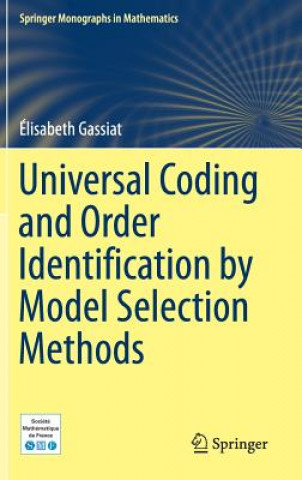
Könyv Universal Coding and Order Identification by Model Selection Methods Élisabeth Gassiat

Universal Coding and Order Identification by Model Selection Methods

Nyelv: Angol
Kötés: Kemény kötésű
Kiadó: Springer
Elérhetőség: Beszállítói készleten
Küldés 10-13 napon belül
42 378 Ft
The purpose of these notes is to highlight the far-reaching connections between Information Theory a...


Információk a könyvről

Nyelv
Angol
Kötés
Könyv - Kemény kötésű
Kiadva
2018
oldal
146
EAN
9783319962610
ISBN
3319962612
Enbook ID
19693917
Kiadó
Súly
408
Méretek
156 x 234 x 11

Teljes leírás

The purpose of these notes is to highlight the far-reaching connections between Information Theory and Statistics. Universal coding and adaptive compression are indeed closely related to statistical inference concerning processes and using maximum likelihood or Bayesian methods. The book is divided into four chapters, the first of which introduces readers to lossless coding, provides an intrinsic lower bound on the codeword length in terms of Shannon's entropy, and presents some coding methods that can achieve this lower bound, provided the source distribution is known. In turn, Chapter 2 addresses universal coding on finite alphabets, and seeks to find coding procedures that can achieve the optimal compression rate, regardless of the source distribution. It also quantifies the speed of convergence of the compression rate to the source entropy rate. These powerful results do not extend to infinite alphabets. In Chapter 3, it is shown that there are no universal codes over the class of stationary ergodic sources over a countable alphabet. This negative result prompts at least two different approaches: the introduction of smaller sub-classes of sources known as envelope classes, over which adaptive coding may be feasible, and the redefinition of the performance criterion by focusing on compressing the message pattern. Finally, Chapter 4 deals with the question of order identification in statistics. This question belongs to the class of model selection problems and arises in various practical situations in which the goal is to identify an integer characterizing the model: the length of dependency for a Markov chain, number of hidden states for a hidden Markov chain, and number of populations for a population mixture. The coding ideas and techniques developed in previous chapters allow us to obtain new results in this area. This book is accessible to anyone with a graduate level in Mathematics, and will appeal to information theoreticians and mathematical statisticians alike. Except for Chapter 4, all proofs are detailed and all tools needed to understand the text are reviewed.

Érdekelheti

Ayiti

Vacirca V Vaughn
7 203 Ft

What's Next?

Robert Snyder
77 092 Ft
3 514 Ft
6 817 Ft
2 051 Ft

Azok a vásárlók, akik ezt a könyvet megvásárolták, a következőket is megvásárolták

4 798 Ft
9 124 Ft
5 722 Ft
11 727 Ft

Tito

Vehbiya Ramovic
5 664 Ft