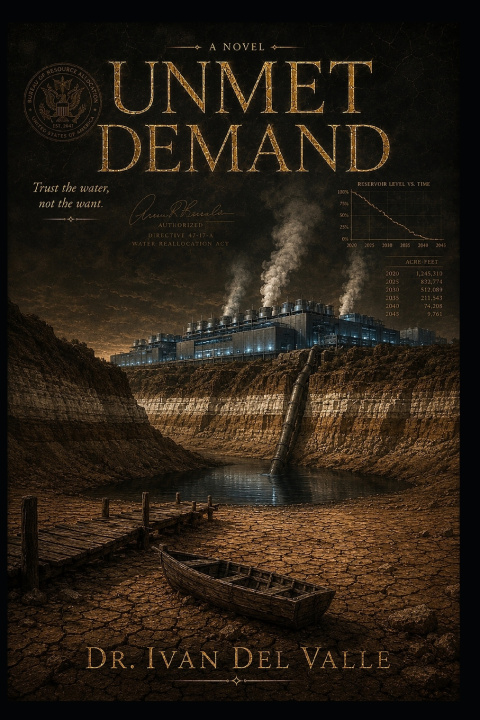
Literary techno-horror in the tradition of Cormac McCarthy's The Road and Paolo Bacigalupi's The Water Knife.
The well had been dry for a year before anyone in the office wrote it down. Delia Telles wrote it down. Then she went looking for the line in the ledger where the water had gone, and found that it balanced.
Delia Telles is in her fifties, Akimel O'odham and Pee-Posh and Mexican-American, and a senior hydrologist at the Arizona Department of Water Resources. For twenty-five years she has reviewed the plans, run the groundwater model, and signed the replenishment credits that keep the desert's accounts in balance. She helped build the very model that now prints the phrase the agency uses for a shortage no one is responsible for: unmet demand.
When a data-center project rises at Sentinel Mesa above the foothill town of Cuervo Bend, the machinery Delia has served all her life begins to work exactly as it was designed to work. Commercial well permits are issued while a subdivision down the road is denied its hundred-year assurance of water. The aquifer falls. The river is already spoken for. And every step of the process is lawful, documented, and signed. Delia fights it with every tool the institution gives her, and the institution answers with the empty chair behind the desk, where there is no one to blame and nothing to appeal.
Unmet Demand is a novel about the moment a system, working exactly as designed, becomes the quiet author of a human fate. The architecture of Arizona and Colorado River water law is real; the foothill town of Cuervo Bend, the company Ardent Compute, and the Sentinel Mesa project are not. The Gila River Indian Community is a real and sovereign nation; its people and officials as portrayed here are fictional. See the copyright-page note on the boundary between the real apparatus and the invented town it empties.
Also available in Spanish.