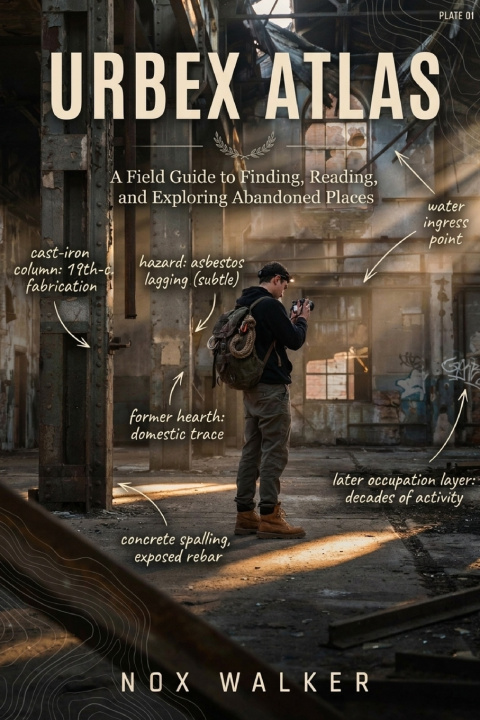
You've felt it - the quiet pull toward a boarded window, the way light slants through a collapsed roof and the world goes still.
That pull isn't just nostalgia or a taste for danger. Every abandoned place is a layered record of human decisions, economic shifts, and nature slowly reclaiming what people left behind. Urbex Atlas teaches you to read those layers... to treat a ruin not as a backdrop for a snapshot, but as a text you can decode, date, and protect.
This is the complete field guide for the explorer who wants more than a thrill. Whether you're standing at the gate of a silent factory, a shuttered hospital, a drowned hotel, or a forgotten rural homestead, you'll learn to turn curiosity into a genuine skill - one grounded in research, observation, and care.
Inside, you'll master all three pillars of urban exploration:
FINDING - Track down sites the right way using historical records, old maps, aerial imagery, newspapers, and local knowledge. Learn to scan the landscape itself for clues most people walk right past - foundations, chimneys, tree lines, and the subtle scars that mark where buildings once stood.
READING - This is what sets serious explorers apart. Decode architectural styles to date a building within a decade. Understand how concrete, brick, wood, and metal decay, and read those processes like a clock. Interpret human traces - graffiti, abandoned objects, layers of use - to reconstruct a site's hidden micro-history on the spot.
EXPLORING - Move through unstable spaces safely with the three-step look-listen-test scan, smart footing, and structural failure awareness. Plan responsible visits, request access, build a reliable team, and pack gear and lighting that actually work in dark, hazardous places.
You'll also get a full chapter on low-light photography and honest storytelling - exposure, tripods, LED and flash technique, and ethical editing that reveals texture without faking a scene - plus deep-dive playbooks for the most iconic site archetypes: factories and mills, hospitals and asylums, hotels and resorts, transit tunnels and depots, and rural farms.
Above all, this book takes ethics, law, and stewardship seriously - the non-negotiable spine that keeps you safe, keeps you legal, and keeps these fragile places intact for those who come after you.
Curiosity is the spark. Skill is what makes it matter.
Pick up Urbex Atlas, learn to read the world's forgotten places, and explore them with the rigor, respect, and confidence they deserve.