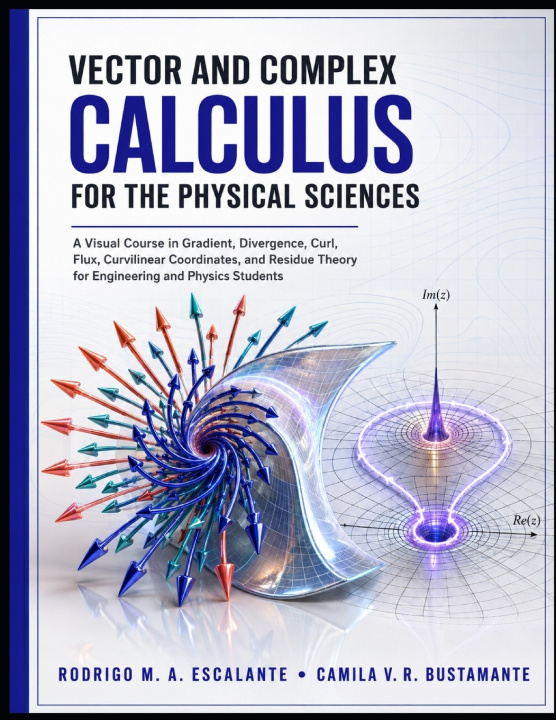
Master the mathematics that physics and engineering are written in, and finally see why it works.
In this subject, a good figure is not decoration but proof. Roughly 200 original, physically accurate diagrams, including arrow and streamline plots, contour and level set maps, flux boxes, oriented surfaces, and complex plane contours, carry the reasoning alongside the algebra, so the operators you have only manipulated symbolically finally acquire shape and meaning.
Part I builds the calculus of fields in space. From vectors, the dot and cross products, and index notation with the Levi Civita symbol and the epsilon delta identity, it develops the three great operators one chapter at a time: the gradient as steepest ascent and normal to level sets, the divergence as flux per unit volume, and the curl as circulation per unit area. It then assembles the second order operators, the full vector identity table, and the Helmholtz decomposition, before turning to line integrals and work, surface and flux integrals, and the unifying theorems of Green, Gauss, and Stokes.
Part II reveals the hidden unity of the subject. An ideal, source free, swirl free two dimensional flow is exactly the real and imaginary structure of an analytic function, the bridge most texts leave implicit. From there the book runs through Euler's formula, analyticity and the Cauchy Riemann equations, contour integration, Cauchy's theorem and integral formula, Taylor and Laurent series, the classification of singularities, and the residue theorem with its full arsenal of contours for real integrals, trigonometric integrals, principal values, and series sums.
Every chapter is engineered to be worked, not just read. Derivations run step by step in both index and vector notation. Five to eleven fully solved examples per chapter carry real numbers to a real answer. Colored callout boxes flag the key ideas and the classic pitfalls. Each chapter ends with 8 problems and 8 complete solutions, backed by a formula appendix, a glossary, and a real page referenced index.
What Is Inside
- The full vector operator toolkit: dot and cross products as geometric instruments, index notation with the Kronecker delta and Levi Civita symbol, and the epsilon delta identity that makes every vector identity a one line proof
- Curves and motion: parametrization, arc length, the Frenet Serret frame, and curvature and torsion computed on real curves
- The three field operators, one chapter each: gradient, divergence with sources and sinks and continuity, and curl with vorticity and the paddle wheel picture
- Second order structure: the Laplacian, the complete vector identity table, scalar and vector potentials, and the Helmholtz decomposition
- Line integrals and work, conservative fields and potentials, parametrized surfaces, orientation, and flux integrals
- Green's, Gauss's, and Stokes's theorems worked and verified, with their payoffs in Gauss's law, Ampere's law, and Archimedes' principle
- The complete complex calculus, from the complex plane and analytic functions to Laurent series, singularities, and the residue theorem
Who It Is For
- Upper level undergraduates in physics, engineering, and applied mathematics meeting field calculus and complex variables in earnest
- Beginning graduate students needing a rigorous refresher before electromagnetism, fluid and solid mechanics, or quantum mechanics
- Engineering students encountering divergence, gradient, curl, and flux in field theory, transport, or signals for the first time
- Self learners and career changers who want geometric intuition beside formal proof