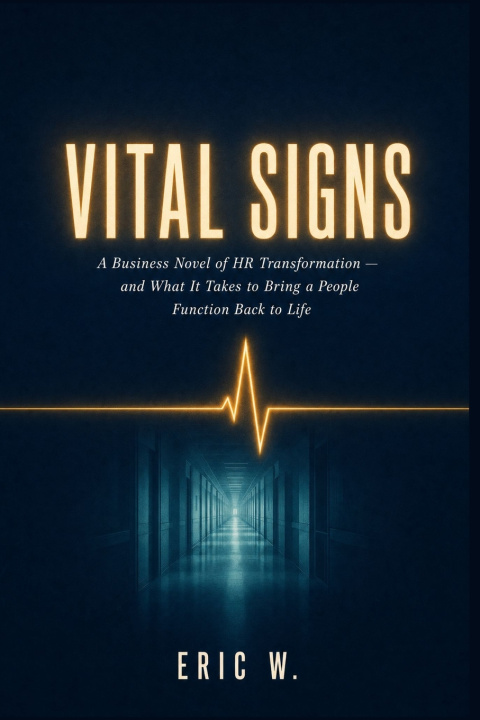
A business novel in the tradition of The Goal and The Phoenix Project, for anyone who has ever tried to fix a broken people function from the inside and been told it couldn't be done.
Anchor Health System is twelve weeks from opening the Beacon Pavilion - a new critical-care tower it cannot afford to open late. A state-mandated nurse-to-patient ratio law is about to take effect. A Joint Commission survey window is open. Two hundred and six nurses must be hired, credentialed, and scheduled before the doors open.
Meg Doyle, Director of Talent Acquisition, was not supposed to be running any of it. But when a data failure pulls fourteen nurses off the floor mid-shift and the CHRO is out by lunchtime, Meg is field-promoted into a function that everyone can see is failing and no one has any idea how to fix. The audit committee wants a plan in thirty days. The board is quietly evaluating whether to outsource HR entirely. The employee pulse survey has just posted the worst results in the organization's history - and the numbers, Meg learns on her first day, are the least of what's broken.
What follows is a summer inside a hospital that finally learns to read its own vital signs - one whiteboard, one honest number, one uncomfortable conversation at a time. Guided by an enigmatic former CPO who teaches by walking her through a hospital's clinical operations at 6:45 in the morning, Meg discovers that fixing a People function isn't a culture problem, or a headcount problem, or a technology problem. It's a systems problem - and the clinicians thirty feet down the hall solved it decades ago.
Sharp, humane, and quietly devastating, Vital Signs dramatizes the invisible work that keeps organizations running, the machinery that makes their reporting lie to them, and the surprisingly ordinary practices - a wall of ugly true numbers, a rule about incomplete work, a permission to run a real experiment - that make the difference between an HR function that gets outsourced and one that gets promoted.
Meg's story is fiction. Anchor Health System is invented. Everything else - the invisible work, the lonely list-keepers, the dashboards that stay green until they can't, the good people getting blamed for the shape of the system around them - will be recognizable to anyone who has ever sat in a rooms where careers, and organizations, are actually decided.
For HR leaders, healthcare executives, operations professionals, and anyone who has ever wondered whether their organization can actually be fixed - or only rearranged.
In the tradition of The Goal by Eliyahu Goldratt and The Phoenix Project by Gene Kim.