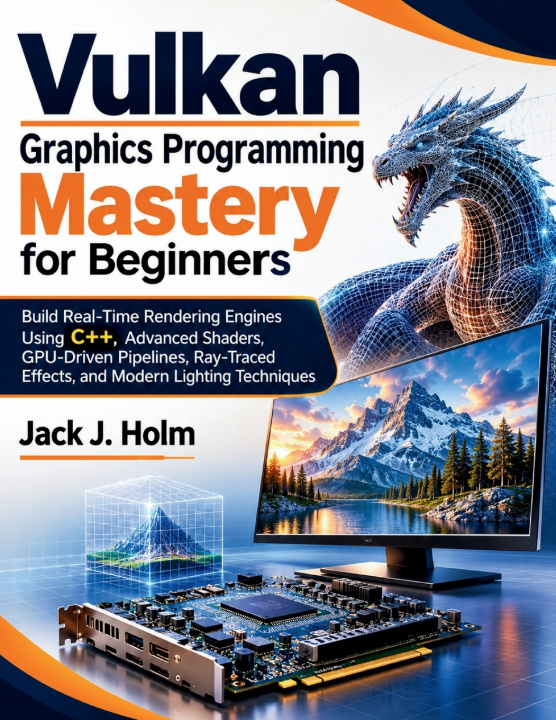
Can you move beyond drawing a triangle on the screen and understand what it takes to make a real-time graphics engine come alive? Vulkan offers remarkable control over modern GPUs, but its power can feel intimidating when command buffers, synchronization, memory management, and shader stages arrive all at once. The challenge is not simply learning an API. It is learning how the pieces work together to produce convincing images.
Vulkan Graphics Programming Mastery for Beginners is designed for readers who want to build that understanding through practical graphics programming concepts. Instead of treating rendering as a collection of mysterious calls, it focuses on the ideas behind a modern rendering pipeline: how CPU and GPU work are coordinated, how resources move through a graphics application, and how shaders transform geometry and lighting into the images you see.
Whether you are an aspiring graphics programmer, a C++ developer curious about GPU programming, a game development enthusiast, or a computer science learner exploring computer graphics, this book gives you a structured way to approach an ambitious subject. You can develop a clearer understanding of Vulkan while connecting its technical foundations to the larger goal of building real-time rendering engines.
Explore the concepts that shape modern graphics development, including:
Vulkan fundamentals and C++ workflows for understanding the structure of a graphics application.
GPU resources, command buffers, and synchronization that help coordinate rendering work.
Shader programming and graphics pipelines for controlling how scenes are processed and displayed.
GPU-driven rendering concepts that reveal ways to organize demanding workloads.
Modern lighting and ray-traced effects that help explain techniques behind more realistic visual results.
The value of learning Vulkan lies in understanding control, not memorizing isolated functions. As you become familiar with the relationship between application code, GPU execution, rendering stages, and visual effects, complex graphics topics become easier to reason about. That foundation can help you read technical documentation with greater confidence, investigate rendering problems more systematically, and make more informed design decisions as your projects grow.
This is not a promise that advanced graphics programming becomes effortless overnight. Vulkan rewards patience, careful thinking, and experimentation. The goal is to make the learning journey more approachable by giving beginners a coherent path into concepts used in modern graphics engines, while offering a useful reference point as their skills develop.
If you want to understand what happens between a C++ program and the pixels produced by a GPU, take the next step. Build your graphics knowledge, explore the architecture of real-time rendering, and begin turning technical curiosity into practical capability. Choose Vulkan Graphics Programming Mastery for Beginners and start exploring the tools and techniques that power modern visual experiences in games today.