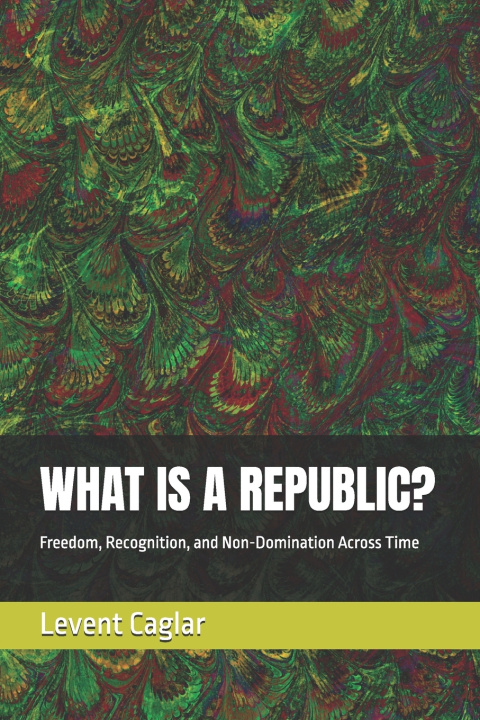
The Life of Nations series began with a deceptively simple question: what is a nation? It ends with the question that the preceding three volumes were preparing: what is a republic, and why does it remain, among all forms of political organization humanity has developed, the most defensible answer to the demands that human dignity places on collective life?
What Is a Republic? is the fourth and final volume of Levent Caglar's Life of Nations series - a project that has traced the political organization of human communities from the foundations of nationhood through the paradoxes of the nation-state, arriving at last at the question of the institutional form best capable of sustaining freedom, dignity, and genuine self-government across time. This volume does not assume its conclusion. It earns it.
The book opens with a diagnostic reckoning. Four chapters systematically examine why political forms lose legitimacy - through the securitization of politics, the privatization of sovereignty, and the monopolization of time. They develop a theory of freedom adequate to the twenty-first century: not mere absence of interference but the sustained institutional condition of non-domination, the structural guarantee that no agent - public or private, governmental or algorithmic - retains the unconstrained capacity to reshape the conditions of another's life without accountability. They diagnose the crisis of the nation-state as the collision between its genuine historical achievements and structural limits it was never designed to govern. And they analyze the crisis of modern democracy not as a cultural failure of citizens but as a structural consequence of institutions that have progressively ceased to deliver what they promise.
From this diagnostic foundation, the book turns to construction. Part II develops the philosophical architecture of the Ethical Republic from the ground up: from human dignity - the intrinsic moral worth in virtue of which every person is entitled to inhabit her own life as its primary author - through individual sovereignty, the civic nation, temporal pluralism, and the constitution as an act of organized political time. A dedicated section develops the concept of cognitive sovereignty as a condition of republican freedom: in an era of algorithmic governance, targeted manipulation, and epistemic fragmentation, the republic's commitment to non-domination must extend to the cognitive space from which political agency flows.
Throughout, the case of Türkiye - the century-long experiment of a republic that has consistently honored its foundational promise in form while systematically betraying it in substance - functions as the concrete political site where the abstract argument meets historical reality. The analysis does not moralize about Türkiye; it diagnoses, from the inside of its constitutional history, the structural mechanisms through which legitimacy is progressively forfeited and the specific conditions under which it can be genuinely restored.
What Is a Republic? is a work of systematic political philosophy in the tradition of non-domination republicanism, enriched by engagement with the temporal dimensions of political life that the tradition has undertheorized. It is, simultaneously, a book addressed to every political generation that must answer, in its own conditions, the question that no political theory can answer for it: what does a political order owe to the human beings it constitutes, and what does their dignity require of those who seek to build one?