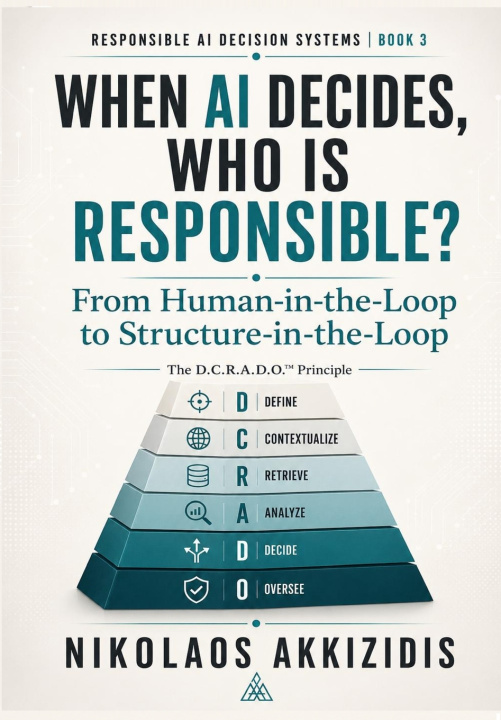
When AI decides, who is responsible?
Artificial Intelligence is no longer simply assisting human judgment. It is increasingly participating in decisions that affect finance, business, law, healthcare, education, public administration, and society itself. But when an AI system influences, recommends, ranks, rejects, approves, or executes a decision, responsibility can no longer be treated as a vague ethical intention or a final human signature.
When AI Decides, Who Is Responsible? introduces a powerful shift in the debate on AI governance: from Human-in-the-Loop to Structure-in-the-Loop.
Nikolaos Akkizidis argues that human oversight alone is not enough when AI systems operate inside complex institutional, regulatory, technological, and economic environments. Responsibility must be embedded into the architecture of decision-making itself. This requires clear structures, defined roles, accountable processes, documented reasoning, defensible oversight, and governance mechanisms capable of transforming AI from a source of uncertainty into a responsible decision partner.
At the heart of the book is the D.C.R.A.D.O.™ Principle, a responsibility framework designed to help individuals, institutions, and regulators understand how decisions involving AI can be controlled, reviewed, authorized, documented, and owned. The book explains why responsibility must not appear only after something goes wrong; it must be designed before the decision is made.
Drawing from finance, compliance, governance, risk management, regulation, and ethical decision-making, this book offers a practical and strategic framework for professionals, executives, policymakers, AI governance leaders, compliance officers, risk managers, and decision-makers who must operate in an age where AI is becoming part of the decision structure.
This is not only a book about artificial intelligence. It is a book about accountability, institutional trust, and the future of responsible decision-making.
Because in the age of AI, the most important question is not only what the machine decides - but who is responsible for the decision.