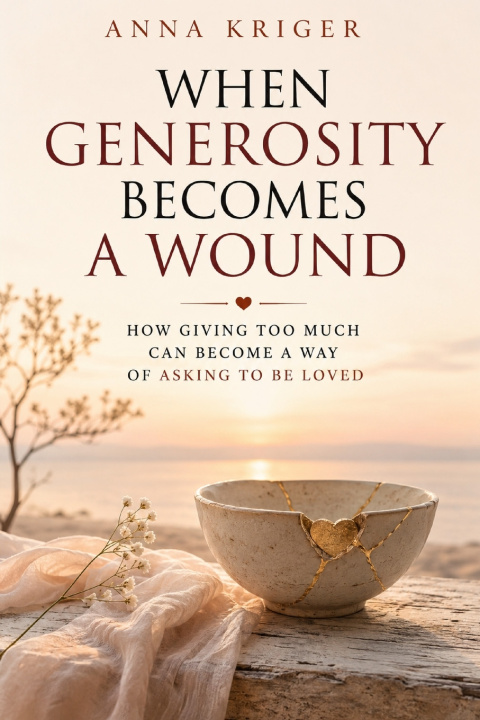
We are taught that generosity is always a virtue, that the person who gives more is the better person, and that love is measured by how much of ourselves we are willing to hand away. But what happens when giving stops coming from fullness and starts coming from fear - fear of being rejected, of being invisible, of not being enough? What happens when kindness quietly becomes a way of begging to be kept?
This is a book about the moment generosity turns into a wound. It begins in childhood, in the life of a girl who had everything except belonging - loved at home, envied outside, bullied by classmates and even by teachers, the white crow who learned that having more could make her guilty, and that giving might make her safe. From that early lesson it traces the long arc of overgiving into adult life: the invisible labor of those who always help, the loneliness of being useful, the yes that was never truly free, and the slow disappearance of a person into other people.
But this is not only a book about the wound of the one who gives. It is also a book about the responsibility of the one who receives. A person is not a resource, not a function, not a convenience for someone else's comfort. To take advantage of another's inability to say no is its own kind of wound - in conscience, in empathy, in love. And so the book asks the harder question: how do we receive without harming the one who gives?
Tender, honest, and quietly radical, this is a meditation on dignity, boundaries, and the courage to be loved without earning it. It moves toward forgiveness - of ourselves, and of the parents who passed down their fear because no one ever healed it in them - and toward a simple, difficult truth: real love does not say, "Since you cannot say no, I will take." It says, "Until your no becomes strong, I will help you guard it."
For everyone who has ever given from an empty place and wondered why they still felt unseen, this book offers something rare: not advice on how to give more, but permission to stop disappearing.
Generosity, Boundaries, Belonging, Self-Worth, Forgiveness, Healing, Relationships