Who taught Christians when and how to celebrate?
The Christian calendar often appears ancient, settled, and unquestionably sacred. Yet the observances now associated with Christianity did not emerge at one moment, from one source, or under one authority. Some practices existed before Constantine. Others developed through imperial patronage, theological calculation, missionary adaptation, medieval devotion, family tradition, commercial expansion, and modern entertainment culture.
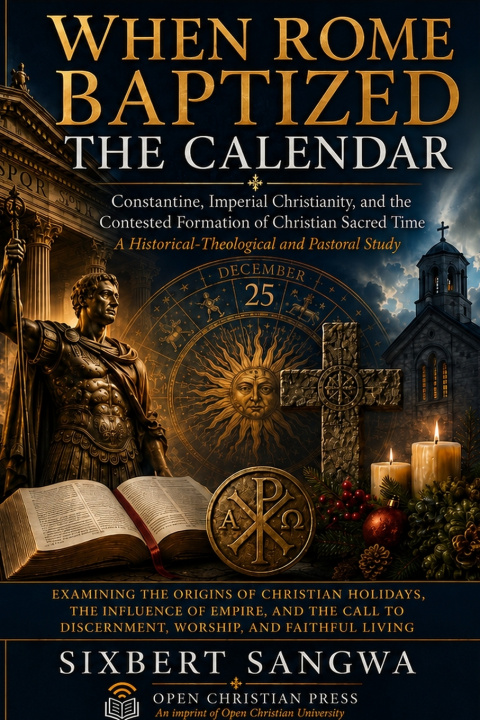
When Rome Baptized the Calendar offers a carefully documented historical, theological, and pastoral investigation into the contested formation of Christian sacred time.
Rather than repeating the simplistic claim that Constantine invented every Christian feast, Sixbert Sangwa examines what changed when Christianity moved from a periodically persecuted faith to an imperially favoured institution. He explores how law, political power, church authority, monumental architecture, public ceremonies, social pressure, and economic interests helped transform diverse Christian practices into increasingly standardized systems of sacred time.
The book examines major observances and controversies, including:
Christmas and the disputed date of 25 December; Pascha, Passover, and Easter; Lent, Good Friday, and Holy Week; saints' days and devotion to the dead; All Saints, All Souls, and Halloween; Valentine's Day and the Christianization of romantic desire; and the globalization, commercialization, and digital amplification of seasonal celebrations.
This is neither an attack on the incarnation and resurrection of Jesus Christ nor a defence of every inherited tradition. The biblical events are true and foundational. The central question is whether later commemorative systems faithfully proclaim those truths or surround them with imperial interests, religious mixture, folklore, consumerism, falsehood, and rival forms of allegiance.
Grounded in Sola Scriptura and informed by primary sources, historical scholarship, archaeology, ritual studies, and contemporary cultural analysis, the book carefully distinguishes documented history from probability, disputed interpretation, and unsupported popular claims.
Its Calendar Discernment Framework helps Christians evaluate not only where a custom came from, but also what it presently teaches, whom it honours, how it forms desire, what fruit it produces, and whether Jesus Christ genuinely remains Lord of the practice.
Written for pastors, church leaders, families, students, scholars, and thoughtful believers, this book provides a biblically serious path beyond both careless conformity and fear-driven rejection. Readers are equipped to decide responsibly whether particular practices should be retained, reformed, replaced, rejected, or used as opportunities for truthful gospel witness.
Christ does not need borrowed authority from empire, commerce, folklore, or cultural tradition. He is already Lord of history, worship, conscience, and time.