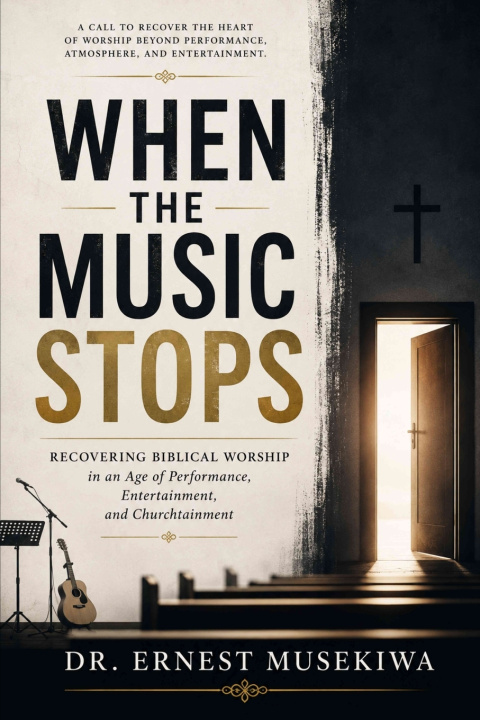
When the Music Stops
What happens when the music ends?
The lights go off. The musicians put away their instruments. The worship leader steps away from the microphone. The congregation leaves the sanctuary and returns to ordinary life.
But does worship continue?
In an age when contemporary church services can increasingly resemble concerts, productions, and theatrical performances, the church must recover a fundamental biblical question: What does it actually mean to worship God?
When the Music Stops is a searching theological and pastoral examination of worship in the contemporary church. It explores the growing tension between genuine worship and performance, between congregational participation and spectatorship, and between biblical worship and what has increasingly become known as "churchtainment."
The book challenges the assumption that worship can be divided simply into fast songs called "praise" and slow songs called "worship." It examines the difference between a musician and a worship leader, arguing that musical ability alone does not constitute spiritual leadership. A musician may capture the attention of an audience, but a worship leader must help direct the hearts of God's people toward God.
Grounded in Scripture and informed by lived experiences within the church, this book addresses the difficult questions that worship leaders, musicians, pastors, and congregations must be willing to confront.
What happens when emotional atmosphere becomes more important than biblical truth?
What happens when excellence becomes performance?
What happens when the worship team becomes the centre of attention?
What happens when congregations become audiences?
What happens when songs are powerful but the lives of worshippers remain unchanged?
And what happens when the music stops?
With a pastoral rather than merely critical voice, Dr. Ernest Musekiwa calls the church back to a worship that is theological, Christ-centred, congregational, holy, truthful, and transformative. He reminds worship leaders that their calling is not to become religious entertainers but servants who help God's people see and respond to the glory of God.
This is a book for worship leaders who want to lead differently, musicians who want their gifts to remain surrendered to God, pastors who want to recover theological depth in worship, and church members who have begun asking whether something essential has been lost.
Because biblical worship is not merely what happens when the band begins to play.
Worship is what remains when the music stops.