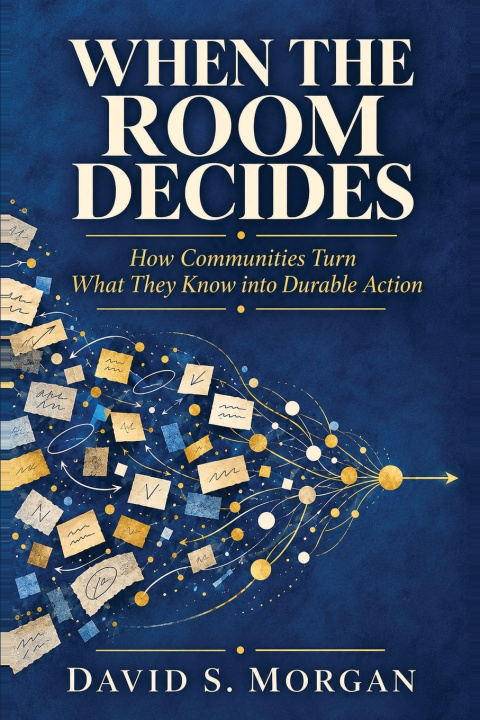
Communities gather, speak honestly, and see what they know. Ideas surface, the room comes alive, and people leave with a sense that something has begun. A few weeks later the energy is gone and the plans sit in a binder. The usual explanation is that people did not follow through. This book argues that the failure is architecture.
In October 2025, sixty people in New Hampshire's North Country held some forty-six conversations over two days of Open Space. David S. Morgan follows what happened next, step by step and on the record. He describes a second listening in which AI helped read the whole record while people set the questions, checked the patterns, and made every decision. He shows the filter that turned what the region said into possible projects, and admits it was his. He walks through the survey that ranked them and the decision session that narrowed eight initiatives and a wildcard to two. And he follows the people who said yes, knowing what it would cost them.
Set beside nine cases across 181 years, the North Country reveals four conditions that lasting collective action requires: Voice, Visibility, Commitment, and Return. The cases are Denmark's folk high schools, Septima Clark's citizenship schools, Paulo Freire's culture circles, SEWA, Dudley Street, Porto Alegre's participatory budgets, South Africa's Truth and Reconciliation Commission, and Buurtzorg. Morgan is candid about power, about who can afford to say yes, and about what funders owe once the room empties. He is equally candid about his own part, including a gathering of his own that produced a newsletter's promise and little else.
Inside you will find:
- Why participatory processes stall after the gathering, and why the cause is architecture rather than apathy
- The Second Listening, a documented, human-led method for using AI to make a community's whole record visible without handing over its judgment
- An honest treatment of power: who can afford to say yes, what saying yes costs, and what a community owes the people who carry its work
- The funder's share: four obligations for money that arrives after a community decides
- A field guide to the full cycle (Listen, Sense, the Threshold, Act, and Return), with practitioner moves and the way each phase fails
- Eight Questions to Carry, Fourteen Questions for reflection, and a guide for reading together
For facilitators, organizers, nonprofit and civic leaders, and funders who want the next room to decide something, and the work to outlast the room.
This accessible ebook includes a structured table of contents, print page numbers from the paperback edition, and an index linked to those pages.