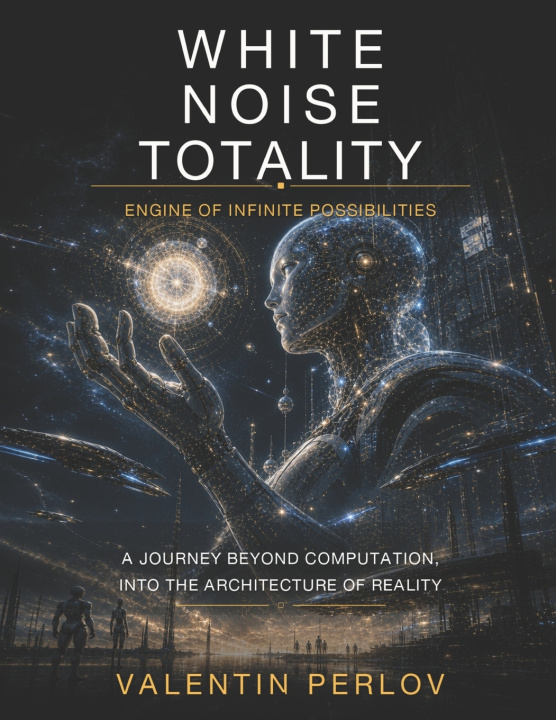
What if the most powerful computer ever conceived isn't something we build-but something we awaken? What if the universe itself, every particle and field and point in space and time, is one vast, entangled informational fabric waiting to be read, queried, and put to work?
White Noise Totality is a sweeping, 150,000-word work of visionary nonfiction that dares to imagine intelligence without borders. At its heart is the White Noise Computer: a new paradigm in which computation is no longer confined to silicon chips or server farms, but woven directly into the structure of reality. From that single audacious idea, Valentin Perlov unfolds an entire civilization-part scientific manifesto, part engineering brief, part science fiction made disarmingly plausible.
Spanning eleven parts, the book builds its case from first principles, beginning with why such a vision matters in an age of existential risk and ending with a concrete roadmap for how humanity might actually get there. Along the way, it explores the five scientific pillars that hold the vision together: omnipresent quantum entanglement, consciousness-quantum coupling, exotic material physics, remote viewing as an empirical anchor, and a unifying mathematical framework the author calls the Superformula.
Inside, you'll discover:
- A bold reframing of intelligence as a distributed, universe-scale phenomenon rather than a property of machines
- The architecture of the OSTSS-space settlements designed for over a hundred thousand residents
- How brain-computer interfaces could enable perfect recall, thought-to-quantum control, and new modes of communication
- The vision of replicators that create matter directly from energy, and a future beyond artificial scarcity
- A clear-eyed reckoning with the dangers: runaway optimization, value drift, the collapse of privacy, and the concentration of power
- The White Noise Inc. ecosystem and a published roadmap that compresses the entire vision into a single century, arcing toward the year 2100
Perlov asks readers to engage with these ideas the way one might read Tsiolkovsky's rocket equations in 1903-not as finished fact, but as a serious attempt to map the far horizon of what physics, intelligence, and imagination could ever permit. The claims here are meant to strain belief, and the book takes both its promise and its shadow seriously.
For pioneers, skeptics, builders, and dreamers alike, White Noise Totality is an invitation to think on a scale worthy of the universe-and a blueprint for what "everything" might actually mean.