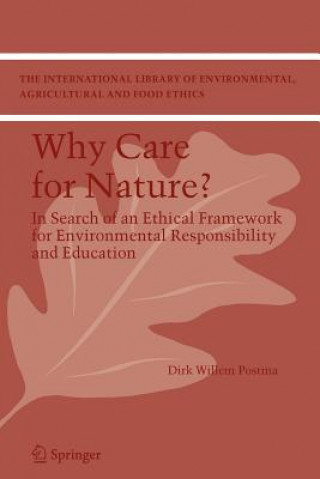
"For environmental educators who are searching for theoretical foundations that support critical dialogue on why humans must care for nature, Postma gives a strong theoretical introduction to this under-explored field with extremely important consequences for the planet s survival."§- Greg W. Misiaszek, Book Review in InterActions: UCLA Journal of Education and Information Studies, Vol. 5, Issue 1, 2009 §The book addresses those educational professionals, policy-makers, academic researchers, students and scholars who are somehow involved in the discourse on environmental education and sustainable development. While the book is first and foremost a research monograph, it might be used as an introduction to environmental philosophy by postgraduate students in educational studies, or as an introduction to educational issues by postgraduate students in environmental studies. While the issues discussed are complex and abstract, the book is readable for a general audience. No specific knowledge and philosophical training are assumed. New terms, distinctions and jargon are introduced and explicated by the author. Furthermore, the crucial insights and arguments are frequently restated in intermediate summaries and conclusions. §That the subject area of environmental education is widely studied, discussed and taught is manifest in the widespread dissemination of journals on environmental education (there are at least five journals in the English speaking world), the manifold conferences and the existence of locally rooted networks of researchers, policy-makers and practitioners on this subject. Furthermore, the last few years, the subject of environmental education has attracted much attention in general academic media (take for instance the special issues of the Journal of Philosophy of Education, Cambridge Journal of Education, Education Philosophy and Theory). Moreover, the recent declaration of the upcoming decade of 2005-2015 as the United Nations Decade on Education for Sustainable Development is likely to increase potential readership in the near future. The subject of environmental education appears to be of particular importance in Australia and New Zealand, where the evident need for nature conservation and protection against ultraviolet radiation has granted relevance to environmental concerns in connection to educational concernsThis book is a rigorous, yet accessible introduction into the current philosophical discourses underpinning practices of environmental education. It provides a comprehensive theoretical framework, relating philosophical key issues and educational concerns in an intrinsic manner, against the background of current practices and policies. While the issues discussed are complex and abstract, the book is readable for a general audience.What is it that inspires us humans tot take responsibility for our involvement with the natural environment? And how do we familiarise children with practices of environmental responsibility? These questions are at the heart of this book, resulting from a comprehensive inquiry into the ethical and politico-philosophical dimensions of environmental education. Two sources of inspiration and responsibility are discussed in particular. First, as citizens of a civil society, inspiration stems from our commitment to the continuation of the collective practices in which we are already engaged. Second, inspiration emerges from our sensual-aesthetic acquaintanceship with the natural surroundings in the course of our everyday activities. This study concludes that there is insufficient room for these sources of inspiration and responsibility within the prevailing framework of Education for Sustainable Development (ESD). An alternative view on the nature and purpose of environmental education is put forward in light of these shortcomings. This view aims to retrieve an existential human sense of care for our natural environment, beyond the narrowly defined appeals made on behalf of future generations, as well as beyond the romantic appeals made on behalf of the intrinsic sovereignty of nature.