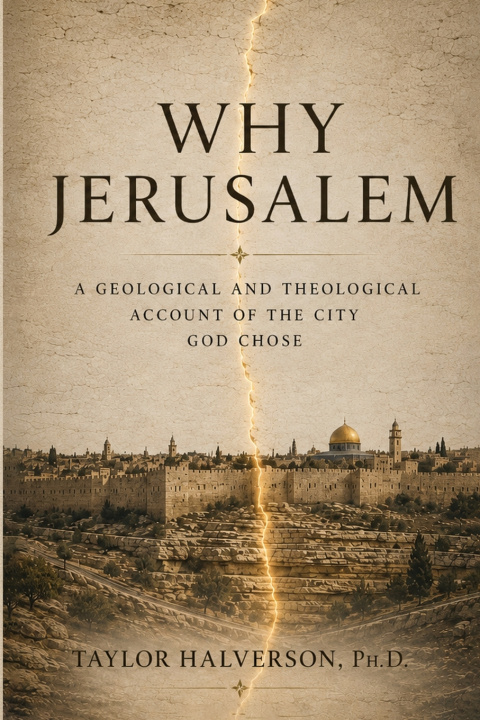
What if the answer to why God chose Jerusalem begins ninety million years before Abraham?
Why Jerusalem? Why did Abraham come here? Why did David make it his capital? Why did Solomon build the temple here? Why did prophets speak of it, kings fight over it, pilgrims journey to it, and millions revere it as sacred? Of all the places on earth, why this city?
Most answers begin with history.
This book begins millions of years earlier.
Long before Abraham climbed Mount Moriah, before David captured the city, before Solomon built the temple, before prophets preached within its walls, Jerusalem's story was already being written. It was being written in limestone seas, rising mountains, underground springs, fault systems, valleys, and geological processes that unfolded across tens of millions of years.
Why Jerusalem? explores the remarkable convergence of geology and theology that produced one of the world's most influential cities. Drawing upon geology, archaeology, hydrology, biblical studies, ancient Near Eastern history, and Restoration scripture, Taylor Halverson, Ph.D., traces how the physical landscape of Jerusalem shaped the religious imagination of generations and became the setting for some of the most important events in sacred history.
Journey through:
• The ancient seas that produced Jerusalem's limestone
• The tectonic forces that raised the Judean Hills
• The Gihon Spring and the city's water supply
• The valleys, ridges, and natural defenses that shaped settlement
• The geology behind the City of David
• The symbolism of living water
• The theological significance of mountains, rocks, springs, and sacred space
• The relationship between physical landscape and covenant identity
• Why Jerusalem became the city of kings, prophets, temples, and pilgrimage
Along the way, readers discover that the land itself became a teacher. The mountain taught kingship. The spring taught living water. The rock taught stability. The valleys taught judgment and deliverance. The geography became theology.
Written for scripture students, teachers, travelers, and lifelong learners, this book offers a fresh perspective on one of the most important places in human history. Because understanding Jerusalem begins long before the city existed.
And because the question "Why Jerusalem?" may reveal something profound about the God who chose it.