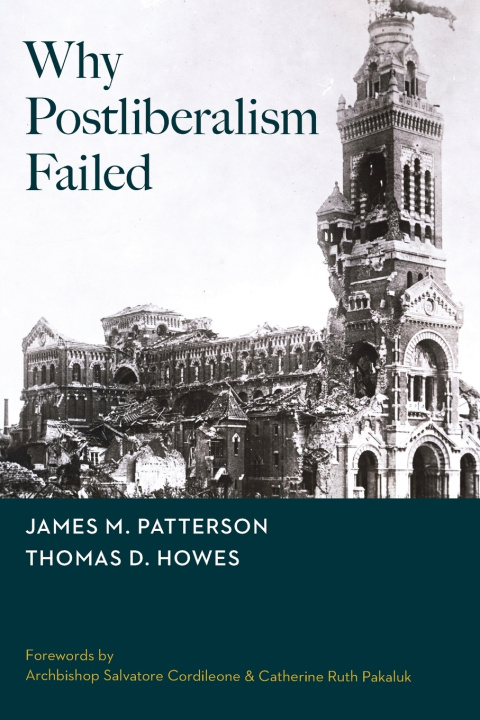
Why Postliberalism Failed offers an indictment of one of the most consequential ideological movements reshaping American and European conservatism today. With leading politicians among its adherents and major conservative institutions captured by its agenda, postliberalism demands serious scrutiny and this book delivers it.
Drawing on deep historical research, the book traces postliberalism's intellectual roots to two traditions: an extreme papalism that subordinates all political authority to Church power, and a reactionary European tradition that explained liberal modernity through conspiracy theories blaming Jews and Freemasons for the downfall of throne and altar. These traditions fused into an ideology that powered authoritarian regimes across Europe and Latin America during the interwar years. These regimes, the actual embodiments of integralist aspirations, were marked by poverty, religious persecution, Nazi collaboration, and genocide.
Thomas D. Howes and James M. Patterson demonstrate how today's postliberals rely on these same poisoned wells. The postliberal vision of Catholic integralism, already repudiated by the Second Vatican Council, promises not a renewal of faith but empty churches and filled cemeteries.
Yet this is ultimately a book of hope. By exposing postliberalism's deadly history and intellectual bankruptcy, the authors present a compelling defense of the authentic American Catholic political tradition, one that has always found in the ordered liberty of constitutional republicanism not an enemy of the faith, but its surest protector.
From the Forewords:
"This book is written especially for those young Catholics who are still open to learning-who sense that something is wrong but are willing to be shown that illiberal church-state regimes are not the solution."
Archbishop Salvatore Cordileone
Archdiocese of San Francisco
"Postliberalism failed for a reason more fundamental than bad politics or bad history, though it has plenty of both. It failed because it lacks an adequate account of human nature and civil society."
Catherine Ruth Pakaluk
The Catholic University of America