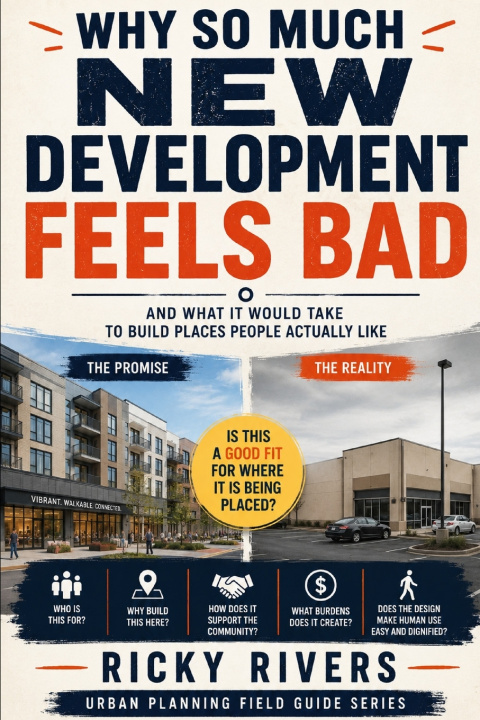
New buildings are everywhere. New apartments. New mixed-use projects. New shopping centers. New restaurants. New offices. New redevelopment sites.
But too often, something feels wrong.
The building may be legal, financed, approved, newly constructed, and full of planning language about walkability, vibrancy, community, or activation. And still, in real life, it feels sterile, confusing, cheap, hostile, disconnected, or not designed for the people who actually have to use it.
Why So Much New Development Feels Bad explains why.
This plain-language field guide looks beyond simple arguments about whether a building is ugly or attractive. It shows how development is shaped by zoning, parking, site design, public realm, cost cutting, mixed-use requirements, access, operations, and the gap between what a project promises and what it actually does.
The book asks one central question:
Is this a good fit for where it is being placed?
Not "does it copy the neighborhood?"
Not "do I personally like the style?"
But does the use, scale, access, operation, public realm, and human experience make sense in this location?
Inside, readers will learn how to evaluate:
- Why some new buildings feel sterile or mass-produced
- Why mixed-use development often fails at the ground floor
- How parking can support a place - or become its public face
- Why "human scale" is not just about building height
- How value engineering can cut the features people depend on most
- Why the public realm is not leftover space
- What residents should ask at public meetings before saying yes or no
This book is not anti-development. It is anti-bad-fit development.
Cities and communities need housing, stores, services, jobs, and new investment. But new development should still answer basic civic questions: Who is this for? Why here? How does it support the surrounding community? What burdens does it create, and who absorbs them?
Part of the
Urban Planning Field Guide Series, this book gives ordinary readers a practical framework for understanding new development before bad design choices become permanent.