Somewhere on your phone there is a list of everything wrong with you. You have been working on it for years.
You track your sleep, your steps, your streaks. You have goals for your mornings, your moods, your relationships, even your past. You are always working on yourself, and you are always, somehow, behind. And nobody has ever asked the only question that matters: who decided you were a project?
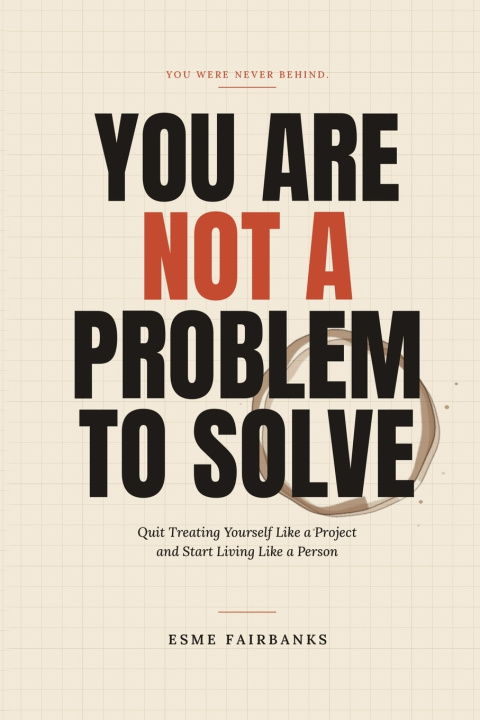
Esme Fairbanks spent nineteen years as a certified project manager. Then her sister found the spreadsheet on her laptop: forty-one rows of corrective actions, a status column that read Behind, and a due date for grieving her father. Her sister asked one question. Who's the client? This book is the long answer.
You Are Not a Problem to Solve is about the quiet way we have all learned to treat ourselves like unfinished work, and about what it costs: the life postponed until you are fixed, the exhaustion no vacation touches, the sense of being late for a schedule nobody issued, the marriage run like a quarterly review. And it is about the alternative, which is not laziness and not giving up. It is a different category. You are a person. Persons have weather and histories and bodies and people who love them, and none of that was ever a defect in the plan.
With warmth, precision, and an elegant sense of humor, Fairbanks gives you the one question that sorts what actually needs fixing from what only needs living, shows why every arrival fades and every metric eventually lies, teaches you how to retire your inner manager with honor and give her real work, and hands you one small daily practice, the unfixed hour, that lets you find out what it is like to be with yourself when no one is being assessed. Every chapter ends with a single doable act, the whole method fits on one page, and the science behind it is cited so you can check it yourself.
If you have read all the books, done all the programs, and still feel like a before photo waiting for an after, this is the book that finally lets you put the clipboard down.
Nothing here is due. You were never the project. You were always the point.