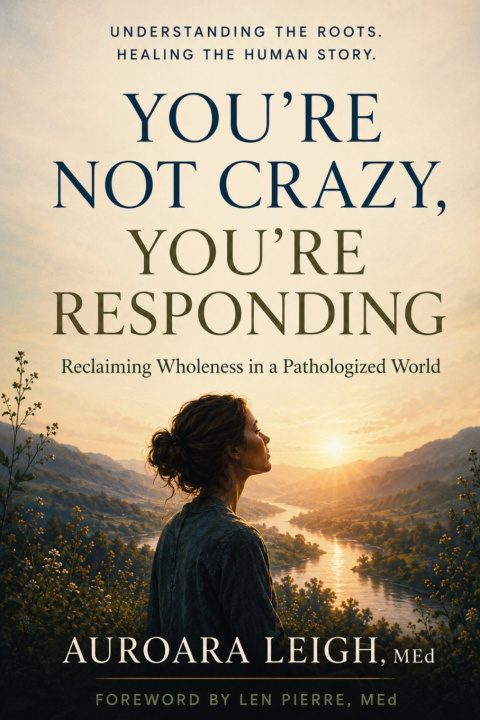
What if the reactions you have spent years trying to control are evidence of how intelligently your body learned to survive?
In You're Not Crazy, You're Responding, Canadian wellness anthropologist and educator Auroara Leigh offers a compassionate, trauma-informed exploration of human pain, mental health, and healing. Drawing together anthropology, neuroscience, somatic awareness, cultural knowledge, memoir, and lived experience, she examines how anxiety, hypervigilance, shutdown, anger, numbness, exhaustion, and emotional overwhelm can develop as protective responses to unsafe experiences, chronic stress, family patterns, and harmful systems.
Your body has been carrying your story, often from long before you had words for what happened. Understanding that story can change the questions you ask about yourself. Instead of beginning with judgment, this book invites you to begin with context, curiosity, and care.
Leigh explores how childhood trauma, social conditioning, cultural disruption, generational pain, and institutional practices shape the nervous system and the beliefs people carry about themselves. She introduces traum-our, the protective armour created through unprocessed pain, and considers how safety, connection, reciprocity, and belonging can allow that armour to soften over time.
Part personal journey, part cultural reckoning, and part map toward a more humane society, this book asks courageous questions about the ways pain is named, diagnosed, and treated. It expands the conversation around trauma recovery and emotional well-being to include the body, relationships, culture, ceremony, community, and the social conditions in which people live.
Inside these pages, you will explore:
• How survival responses develop within the nervous system • Why protective patterns are often mistaken for personal flaws • The effects of childhood trauma, chronic stress, and emotional neglect • How shame and social conditioning influence identity • The connection between individual, cultural, and generational trauma • How traum-our protects us and what helps it soften • The stress loops that keep people and communities in survival mode • The role of somatic awareness, self-compassion, and nervous-system regulation • How families, schools, healthcare systems, and institutions can respond more humanely • What it could mean to reweave care, reciprocity, belonging, and collective well-being
This book is written for two readers at once. It is for anyone on a healing journey who has wondered why they react, withdraw, overwork, disconnect, or remain constantly alert. It is also for parents, educators, counsellors, therapists, coaches, healthcare practitioners, community workers, and leaders who want to understand human behaviour through a trauma-informed and culturally responsive lens.
Designed to complement counselling, medical care, cultural practice, ceremony, and other forms of support, You're Not Crazy, You're Responding offers language for experiences that can be difficult to explain. It encourages readers to recognize signals within the body, understand the purpose behind protective patterns, and approach healing with patience rather than shame.
Auroara Leigh writes with academic insight and the honesty of lived experience. Her work connects personal healing with a larger cultural question: what becomes possible when people and institutions stop treating pain as proof of failure and begin responding with understanding? How do we re-write the pathologization narrative to one that is willing to treat the entire ecosystem that humans develop in?
There is more to your story than the labels you have carried. In fact, the labels are the smoke, and the cultural context is the fire. Let's start carrying water together.